
Day 3 – Southern Africa
So sorry for not posting yesterday immediately following our experience in Alexandra Township and Soweto yesterday. I am at such a loss for words to describe the range of emotions felt during our Taste of South Africa tour to Liliesleaf Farm, Alexandra Township, and Soweto. We also managed to squeeze in a drive through several of Johannesburg’s most well-to-do neighborhoods near Sandton, for a stark comparison to what we experienced in Alexandra and some parts of Soweto.
As my goal here is to provide you with just enough information to stir your interest, or perhaps even increase your interest in South Africa such that you will allow me to tailor a trip just for you, or join me on my next group trip, I will not re-live every moment of the experience here. What I can tell you is that despite having visited several times before, I would come here a thousand times more. With just about every thoughtful encounter with the people here, I learn more about humanity – particularly what motivates us and to what extent we will go to preserve our lives. I have so much to say about this place, but I know many of you are not keen on political discussion when it comes to vacations. For you, enjoy the photos and their brief discussions. For the others, feel free to scroll on down after the photos and follow my thoughts on some of what we witnessed yesterday.
Robin Binckes, our private guide for the day is definitely a Godsend. Again, I will not describe everything about him in detail, but he certainly gave a wonderful overview of apartheid’s beginnings, the contributions of Nelson Mandela and many unsung heroes in its abolishment, and where things currently stand for black, white, and colored South Africans. Robin’s perspective is a unique one, for sure, as a white South African whose family members were amongst the earliest English settlers of the land. Might I note that I’ve heard quite a few perspectives, too…from South Africans across the board relative to race and political view, and surprisingly Robin’s was the common thread united all of them.
To set the tone for a day of contrasts, we drove through Parktown’s streets, lined with multi-million dollar (yes, I’m referencing USD here, not ZAR, South Africa’s currency, one of which is approximately worth about 12 US cents) homes blocked from view by high concrete walls and gates left over from the days of rampant burglary. In the business district of Sandton, a Johannesburg enclave, we breezed by the Johannesburg Stock Exchange, South African headquarters of many firms you may recognize – PwC, Ernst & Young, Vodacom, NedBank to name a few, two Radisson hotels, an Intercontinental, the DaVinci Hotel, and the Michelangelo Towers.
We then headed to Liliesleaf Farm, a very important place in the history of civil rights here in South Africa where the Rivonia 11 Trials were born. No history lesson from me….read about it on your own, then call me to book your tour. Robin brought the day of the arrests at Liliesleaf to life with his narrative as we stood on what many would argue is sacred ground.
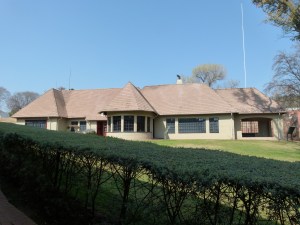
Main House at Liliesleaf Farm
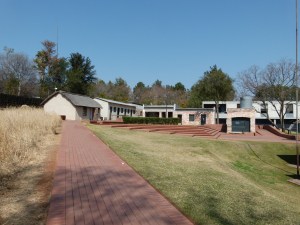
Service houses and storage at Liliesleaf
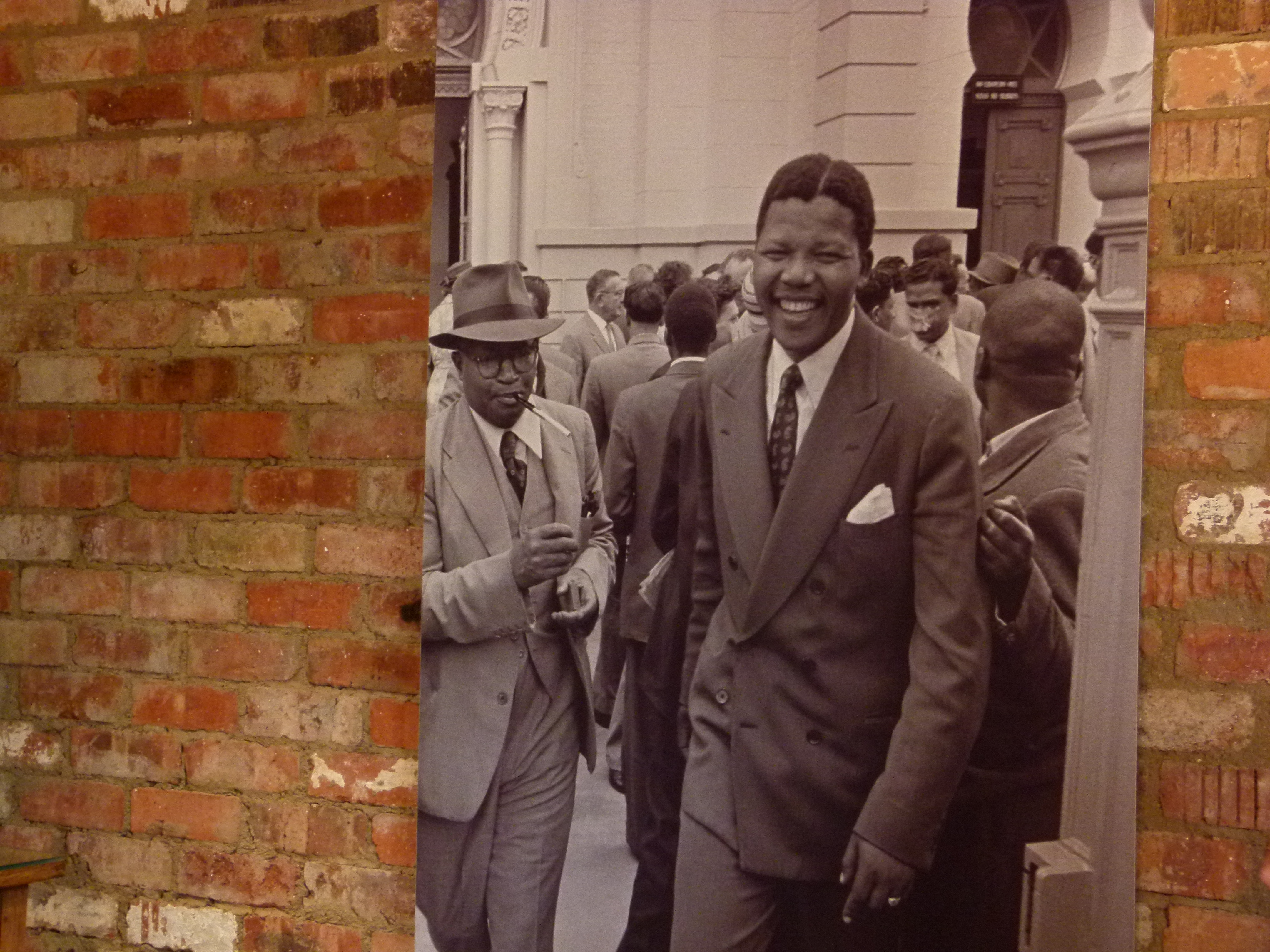
A photo of Mr. Mandela hanging inside his old study at Liliesleaf
After Liliesleaf, we headed to Alexandra Township, the lesser known of Johannesburg’s two major townships which were established for blacks to reside as part of the Group Area Act (you may want to research that act). Robin suggested that most of Alexandra’s residents were worse off than most of Soweto’s, the other Johannesburg township, and I knew he was right as soon as we entered having visited Soweto on previous trips. I will not even attempt to describe the poverty we witnessed, and I will not attempt to dress anything up by saying that everyone still looked happy despite all that they lacked. I will say that everyone knew Robin, and they all smiled when they saw him. We visited his creche, or day care, for young children, and I have never seen a man greeted by so much love all at once by 50 exuberant kids. We were happy to receive an equally warm reception, perhaps by our association with Robin, as he described us as his friends from America. No one held out a hand to ask for anything. We all only received hugs, high fives, thumbs-ups, and leg tugs. In the midst of all those hugs and smiles and literal jumps for joy for Robin and us, I realized that I had never experienced such a genuine sense of “I’m so happy to see you that I cannot contain myself” from anyone other than family members and extremely close friends. This love was about as innocent as you will ever see from another human being, and I will hold onto that memory forever. They were so mannerable, so warm and friendly, beyond beautiful. When we left, I was truly sad to leave, and even more pained by the horrible living conditions we saw as we drove by the shacks many of those children call home. As we approached the intersection we’d cross leaving the township, I suddenly realized that the sprawling complex of modern buildings directly in front of us, perched high on a hill looking directly at us was Sandton, one of, if not THE wealthiest neighborhood in all of Africa. Two places, perhaps not even 5 miles apart, yet worlds away, staring squarely at each other all day, every day. Life couldn’t be so different between Alexandra and Sandton, but what I realized as we were sitting at that stop light, is that residents in both communities, in all communities have the same goal – survival. More on that later in today’s post.
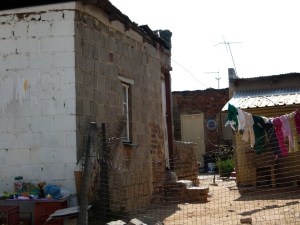
View of Nelson Mandela’s former Alexandra Township home
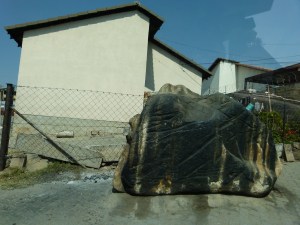
Huge rocks like these found throughout Alexandra serve as barriers preventing drunken drivers from crashing through homes (and they are also covered in oil to prevent loiterers)
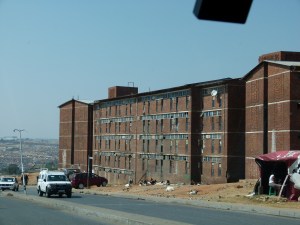
Just outside a hostel for men intended to house 5,000
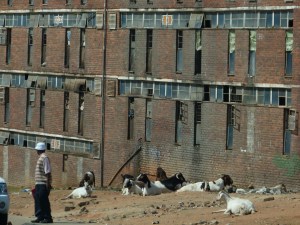
A closer look
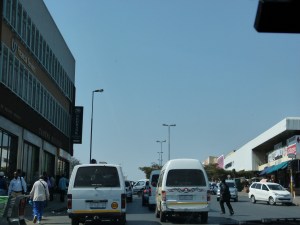
Shared transport vans carrying workers to and from Alexandra
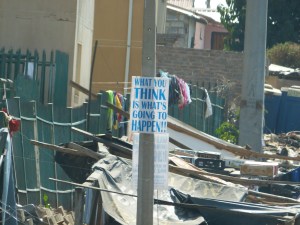
As a man thinketh, so is he
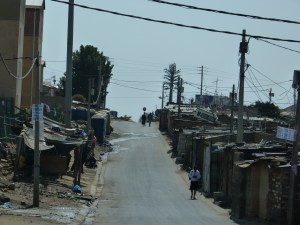
Typical street lined with shacks within Alexandra
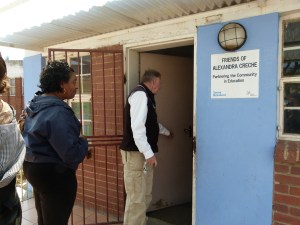
On our way inside Friends of Alexandra, one of Robin’s outreach programs for the children of Alexandra
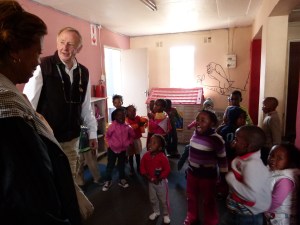
The kids were thrilled to see us
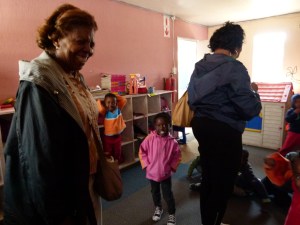
Making new friends
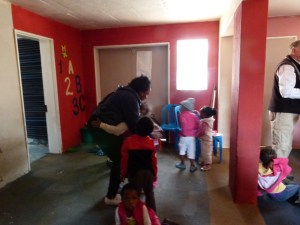
Hugs for everyone!
Next up was Soweto, which, thanks to the World Cup events in 2009 held throughout South Africa, appears to have improved quite a bit since the last time I visited in 2008. The area benefitted from tourism preparation, and there are a few more parks in which Soweto’s children play, more low-cost housing that replaced many of the shacks, and a renewed sense of pride. Still, there is poverty of course, and some does rival what we saw in Alexandra, but things have changed for the better in Soweto. We passed Nelson Mandela’s former home, Hector Pieterson’s house and Museum, Bishop Tutu’s home, and Regina Mundi Catholic Church. I’m not going to describe the significance of those people and places, but you may want to do some reading on your own if you’re interested.
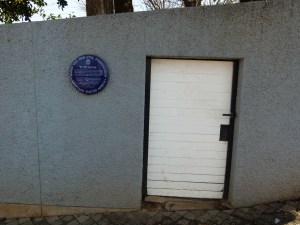
Just outside Bishop Tutu’s home
Robin stopped us at Sakhumzi Restaurant for lunch, and while everyone else wanted seconds on the sausage, I couldn’t get enough of the curried cabbage. I had no choice but to be done, however, because they were all out. I’d only had half a spoon’s full, but I was hooked. That alone would be worth a trip back to Soweto.
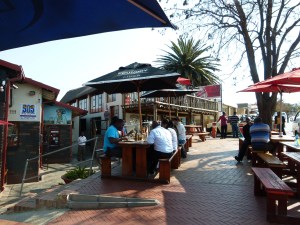
Dining al fresco at Sakhumzi
And all throughout the day, Robin infused our visit to each stop with poignant reflection. We were each completely engaged in the story of ALL of South Africa’s people. I want so much to share more, but….you have to go for yourself. And no, I can’t imagine that your trip will be ruined because of what you see in the townships. In fact, you may even be inspired to do more, be more than ever before.
So, I said earlier that I had more to say for those who were interested, well here’s just a small part of my thoughts from yesterday related to apartheid and the townships.
Whether the actions we take to preserve, and even propel ourselves toward our goals are good or bad is relative. When we remove judgment around whether one’s actions are good or bad, we realize they have the same end, self preservation. I guess what I’m trying to say here is that the people who are in Alexandra Township, an area that brings to mind the old Sally Struthers Feed the Children commercials with children wandering in filth, living in shacks without water, electricity, clean water (or any water at all), or food are trying to survive and do whatever they can, whether “bad” or “good” to do that. Similarly, those who drafted, enacted, enforced, upheld, enabled, etc. the apartheid laws which resulted in much of the abject poverty we still see today, were/are (many of them are still alive, and are holding on to their beliefs) trying to survive, though perhaps on a grander scale. Yes, South Africa has been “free” since 1994, but so has everyone in the US since 1865. The manifestations of the legacies of apartheid in South Africa and slavery in the US are still very much alive. Beyond what we can physically see, the biggest remnant of these institutions lies in the psyche of the oppressor and the oppressed, the perceived winner and the perceived victim, and their future generations for who knows how long.
Whatever the case, self preservation is the bottom line, and that can mean that my gain is achieved from your loss regardless of which party we’re talking about here. Of course South Africa is not unique – this takes place unfortunately on some level in every country, every society, and has taken place throughout time. Though I was not yet born when the world watched America’s most well-known civil rights leaders throughout the 60’s and 70’s work to bring about changes that I am benefitting from right now, I have experienced my share of confrontations in this area. While they can hardly compare to what my parents and those before them experienced, I have had challenges of my own in the 80’s, 90’s, and even within recent years and I know how difficult it’s been for me at times to determine the most effective way to combat my civil rights issues. So for a country proclaiming freedom for all since 1994, it’s amazing to me that they’ve gotten this far in 18 years, and that there has not been more mass resistance since then.
I have no simple remedy for poverty. Of course education is extremely important, but so is employment once a student graduates. Without income no matter how much education you have, you can’t address your basic needs – clothing, food, shelter. If you have any ounce of care in you toward your fellow man or woman no matter his or her political views, race, religion, profession, or favorite sports team, you’d value life enough to agree that these people need help and not be deterred from giving help even if you might believe that you’re only extending their lives just a little longer. Clearly, I want every single financial contribution to go toward clothing, feeding, protecting, and educating those who need it, and I will continue to do what I can. But something in addition to financial contributions is required to change the mentality of those who are struggling to survive in Alexandra and its sister communities around the world, and those who are doing all that they can to maintain their dominance to the point of continued oppression. I just wish I knew what that something should be.
 The Cause Me to Travel Blog
You must be logged in to post a comment.